Blog
Detecting lies: body language vs. lie detector test Part 1


Lies must not be ignored!
Sometimes there is no other choice and you decide to lie instead of telling the truth. But the protection a lie can offer is only an illusion.
Even if you think you are a well-trained and experienced liar, there are signs and signals that can give you away. Whether facial expressions or gestures, voice or choice of words … lies cannot mask the truth, even if you rely on them. People often lie out of panic or ignorance, and the person being lied to senses that something is not right. So what should you do when you have such a feeling?
- Recognize the situation in time
- Ask for the truth
- Prove that lying doesn’t pay off
Before every lie there is the truth
Statistics have shown that women often sense intuitively when something is wrong. It’s not for nothing that mothers keep asking whether everything is all right. But men, too, have the ability to recognize false statements. What is the reason for this universal ability? Can it be learned? Is it innate? Partly it is a social skill, since we know the speech habits of the group and typical gestures. However, this way of recognizing the truth is the result of hard work. It takes an intense relationship with the liar to be able to recognize their secretive attitude.
So the feeling that something is wrong comes partly from nature and partly from your own experience. But you can’t always guess intuitively what exactly is wrong. The truth behind the lie can only be revealed in targeted, professional ways. The options: the ability to ask the right questions and thus find out the truth through communication – or the use of lie detectors.
In contrast to an interrogation, questioning with a lie detector is one-way only; the person being questioned doesn’t even have to answer, since the machine measures the stress factors of their body and shows when an answer deviates – or why the person is silent. With the right questions, the whole truth can finally be put into words.
The truth belongs to reality and also shapes it. Lies try to deny reality and can cause misunderstandings and misfortunes. With the ability to detect lies, such problems can be prevented in good time.

2. Interpreting body signals
Interpreting body signals
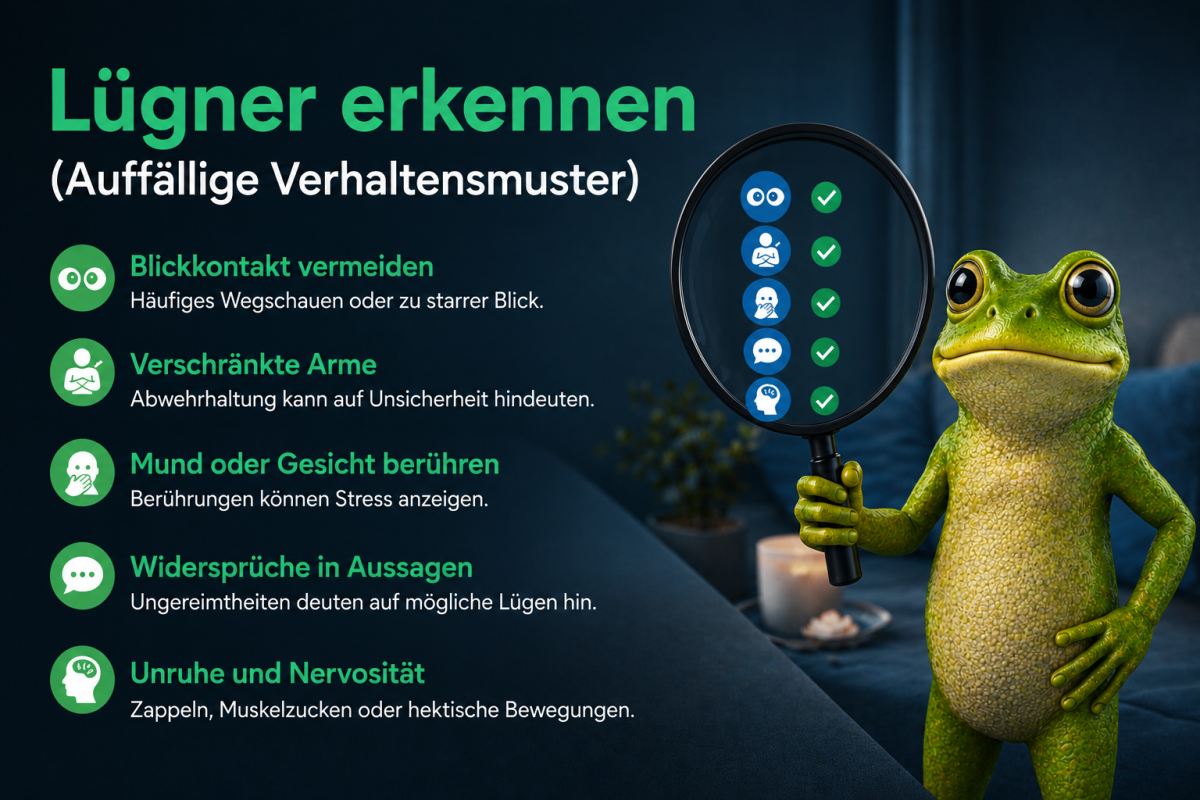
Countless Hollywood movies show scenes in which secret agents take a very close look at suspects and realize that they are being lied to. In fact, a program was developed at the FBI and CIA to help identify the emotions and states of mind of the people being observed. Averted eye contact, sweaty hands, drumming fingers – all signals of stress and impatience. Indications in the typology of body language that suggest the person is feeling very insecure at that moment. In such situations, people often speak calmly and seemingly thoughtfully, but their body indicates a different state.
However, these signals are external signals that can be faked. Many liars are also very good actors. The role of a lie detector is to record and identify the body’s signals objectively and correctly. It no longer observes posture, but heart rate and hormone balance. These biochemical properties of the body can only be controlled with an enormous amount of practice, and in most cases this is almost impossible.
The lie detector exposes the psychological masking of tell-tale body signals. The University of Passau has written a report on body language covering the various possibilities.
3. Language and voice when lying
Spoken statements reshape the truth
In linguistics, there are several disciplines that deal specifically with different aspects of language and speech acts. Sociolinguistics and cognitive linguistics are just two of them, but perhaps two of the most important.
The scientists in these two fields of research are interested in how people communicate within a community and which biological and neural aspects are necessary for a spoken statement to express its content in the desired form and tone of voice.
-
- Sometimes louder, sometimes quieter, sometimes faster, sometimes more curt
- Recognizing intonation and laughter as signs of lying
- A calm voice can also be deceptive
Language and voice when lying
Sociolinguists are mainly concerned with aspects of content such as vocabulary, dialect, sociolect, grammar and syntax that appear as typical examples in certain situations. Whether a statement is right or wrong, contains the truth or is a lie can of course not be determined without the context. But there are elements – such as very pedantic phrasing, flattering remarks or very short yes/no answers – that point to a change in the natural flow of conversation and suggest that the speaker may have something to hide here, or simply prefers their own version to the actual one.
Conversation analysts also pay attention to the side effects of conversations. Laughing, coughing, speaking loudly or becoming quieter are all signs of a deviation. If these appear unexpectedly, the listener should ask themselves what is actually causing them. For example, a sudden burst of laughter or an embarrassed cough can be used as a diversionary tactic. In addition, there are doctors and psychologists who are already working on a method to recognize character traits and even illnesses from the sound of the voice. An article from zeit.de – a little-girl voice is probably looking for a protector…
However, it is no secret that with the right practice, any insecurity and amateurish masking of the truth can be avoided professionally. Actors and TV presenters are the best examples of how you can say something that is not always true without batting an eyelid – clearly, calmly and likeably. A person can be deceived by this, but a machine cannot. The lie detector measures the frequency of the vocal cords and compares it with the natural values.
The size of the deviation can be interpreted as an indication of how truthful the statement is.